
Hand an activity description to someone who has never met you and ask them to tell you back what you did. If they can’t picture it, your verbs are too vague. If they can’t decode it, you’ve leaned on acronyms or names only your school knows. Fixing those two problems repairs most weak college application activity descriptions.
This month, a senior I’ll call Ericka read me the description for her favorite activity. For four years, she has coached first graders at a youth basketball clinic. Her high school coach asked a few players to pitch in when she was in 9th grade, and she’s the only one who stayed.
Her draft said she would “teach fundamental skills,” “direct group sessions,” “encourage teamwork and sportsmanship,” and “keep children engaged.” Every word of it was true. I could tell she knew what she was doing out there, and I still had no idea what she did.
So I asked. Encourage how? Are you giving them a thumbs-up and an attaboy, or are you doing something?
She was doing plenty. During one-on-one drills, the trash talk starts (they’re six), and she steps in to remind everyone they’re on the same team. When nobody is listening to her instructions because they’re sitting on the gym floor or dribbling while she talks, she starts a game of Simon Says in the middle of practice.
None of that had made it into the description. Most first drafts have the same problem, and I have a test for it that takes about five seconds. I call it the Stranger Test.
What is the Stranger Test?
Read your description out loud to someone who has never met you, never seen your school, and knows nothing about your life. Then ask them to tell you back what you did.
There are two ways to fail. Either the stranger can’t picture it, or the stranger can’t decode it.
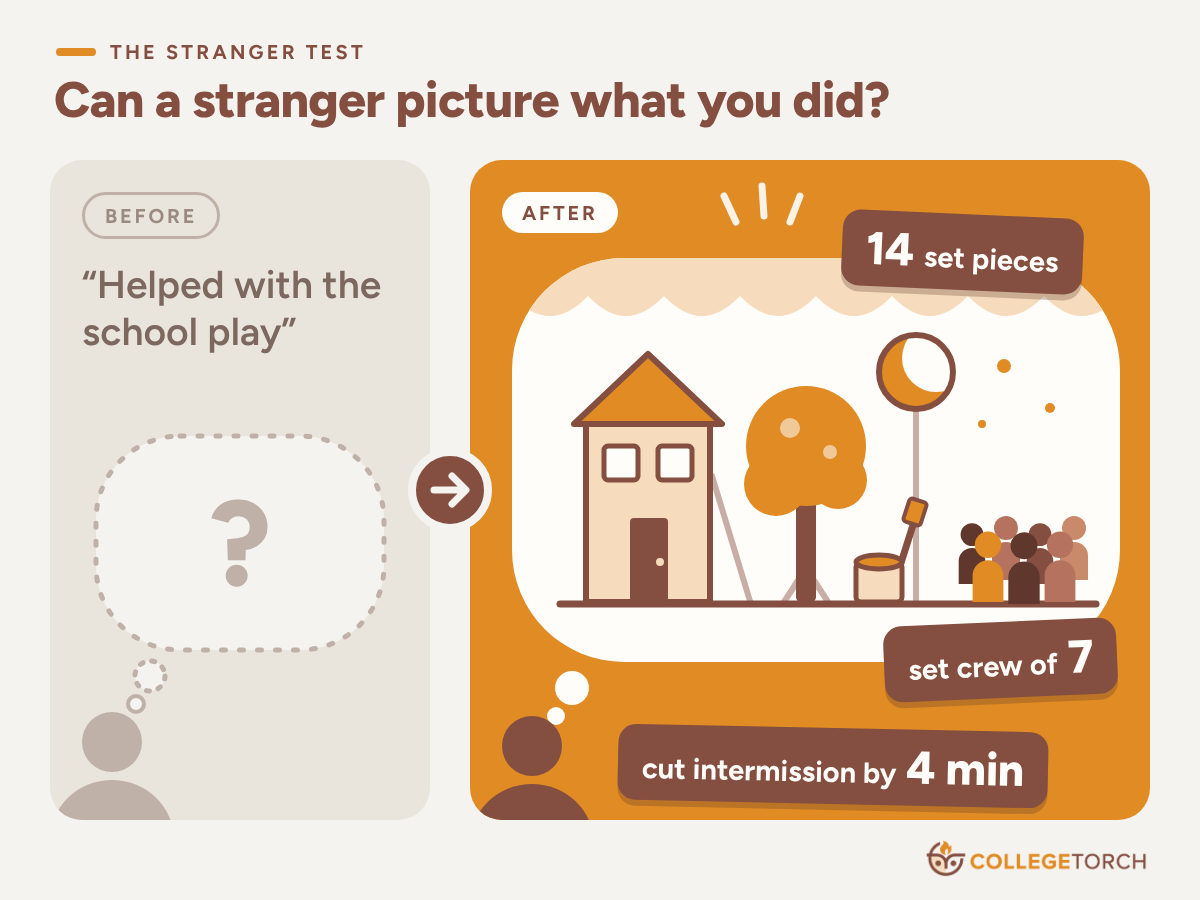
The first kind is easy to spot in its plainest form. Try to picture the student who wrote “Helped with the school play.” Now try “Built and painted 14 set pieces for fall musical; ran set crew of 7 in tech week; designed quick-change system that cut intermission by 4 min.” You know what the second student did, roughly how much, and what came of it.
Why can’t a stranger picture it?
The school play line is the easy case. Real first drafts rarely look that bare. They look like Ericka’s, full of respectable words that give a stranger nothing to look at. I see the same four patterns every fall.
The activity name stands in for the description
A student writes “Member of National Honor Society” and stops. That’s the name of the thing. Did you tutor, organize a drive, or run a committee? NHS is the vehicle, and the description needs to show the ride.
(How you describe an activity matters more than which activity it is. I wrote about that in What Extracurricular Activities Look Best on College Applications?)
Distancing verbs hide the action
“Helped” and “assisted” are what I call distancing verbs, and “participated in” does the same job. They’re always true at some level, which is why they tell a reader so little. Of course you weren’t sorting donations all by yourself. You were still sorting, so say that.
Resume verbs can’t be painted
“Direct,” “manage,” and “encourage” sound like a job posting. Here’s a check I use with my students. Could a painter paint it? A painter can paint someone sorting cans, or stepping between two arguing six-year-olds. Nobody can paint “encouraging teamwork.”
There are no numbers
Numbers make a description believable, and small ones count. The difference between training two new volunteers and training six is enormous. Count the people, the events, the dollars raised, or the articles written. (Skip the hours. The application asks for those in their own boxes.)
I could tell she knew what she was doing out there, and I still had no idea what she did.
What did Ericka change?
It took about five minutes of questions. Here is where three of her phrases landed.
| Her draft | After the questions |
|---|---|
| “Teach fundamental skills” | “Demonstrate dribbling and layup form; organize 1v1 drills” |
| “Encourage teamwork and sportsmanship” | “Step into arguments during drills to reinforce sportsmanship” |
| “Keep children engaged” | “Use verbal cues and quick games of Simon Says to hold focus” |
The activity is the same, and so are the four years. The part about her coach choosing her, and her being the one who stayed, went into the 250-character box where the UC Application asks volunteers to describe the organization.
You get 150 characters for each description on the Common App, as Common App’s guide to the activities section explains. The UC Application gives you 350, and my guide to the UC activities section shows what to do with the extra room.
Why can’t a stranger decode it?
The second failure looks different. The verbs may be fine, and the stranger still gets lost in acronyms, local names, and award shorthand.
Students assume the reader knows their school. Assume the opposite. Your reader knows nothing about your school, your club, or your award, and on the UC Application, no counselor letter or teacher recommendation comes along to explain. The University of California’s own September 2026 training for counselors puts it in three words, “Avoid using acronyms.”
One of my seniors had half a dozen sets of initials across her list this fall. We went through them one at a time, and each got one of three verdicts. Keep it if any reader would know it, spell it out, or cut it. When in doubt, spell it out.
Awards cause the same trouble. Every fall, I work with a student who tries so hard to cram (substantial) awards into the activity descriptions that acronyms and abbreviations take over. There’s no room left for action verbs, so the reader has to infer what the student did from the organization names and positions.
It’s fine to use a quick award to enhance an activity. (This is especially true with sports, where the actions tend to repeat between applicants.) When the awards crowd out the actions, though, I move most of them to the Additional Information section (yes, they read it), where the awards can breathe.
Shouldn’t I say what I learned?
You’ll hear this advice, including from the University of California. That same training encourages students to explain what they learned and which skills they developed.
I read that as a prompt for students who are stuck. Colleges do this all the time. The last essay prompt on the Common App invites you to write on any topic of your choice, which tells you the other six are there to get you started.
Strong actions already suggest the lesson. When Ericka steps between two arguing six-year-olds, I don’t need a line telling me she learned patience. “Learned leadership and teamwork” is a phrase any student could write, whatever they did. The more space your actions earn, the more a reader trusts the lesson they’ve inferred.
If you’ve truly run out of things you did (and I’d challenge you to look harder first), a lesson can use the leftover characters.
How do I run the test on my own descriptions?
Give yourself one evening and one willing stranger.
- Put the list away for a day. You can’t be a stranger to something you wrote an hour ago.
- Pick someone who doesn’t know the activity. A parent who drove you to every practice knows too much, so try a grandparent, a neighbor, or a friend from another school.
- Read one description out loud and ask, “What did I do?” If they answer with the name of the club, keep working.
- Have them stop you at every acronym or name they don’t recognize. Give each one a verdict.
- Rewrite with the most specific verb you can find, add a number, and cut any line another student could have written.

And, parents, you can help without touching the keyboard. When your teen reads you a description, resist the urge to rewrite it. Ask what they did there on an ordinary Tuesday, and have them write down what they just told you.
None of this takes a more impressive activity. Ericka had four years at the same clinic and a gym full of first graders the whole time. Try the test tonight on the first description in your list. Read it to a sibling, a neighbor, or whoever is in the kitchen, and if they can tell you what you did, move on to the next one.
Free Download
Find the activities you forgot to list
You probably have more for your Activities List than you think. My free 47 Activities Field Guide shows you what to look for, so you have plenty to run through the Stranger Test.
Get the Activities Field Guide →Free. I’ll send it straight to your inbox.
Robert Powers
Founder, College Torch
Robert Powers is the founder of College Torch, a college counseling practice in Sierra Madre, California, that works with families nationwide. In 10+ years he has guided 300+ students, and 90% go to one of their top three college choices. He holds two degrees from Johns Hopkins, is a Professional Member of IECA, and co-authored a chapter in NACAC’s textbook for college counselors.
IECANACACHECAWACACM.A. Johns Hopkins
Book a free Right-Fit Call | Meet Robert | Parent group on Facebook